How to Choose the Right Shoe Size When Shopping Online
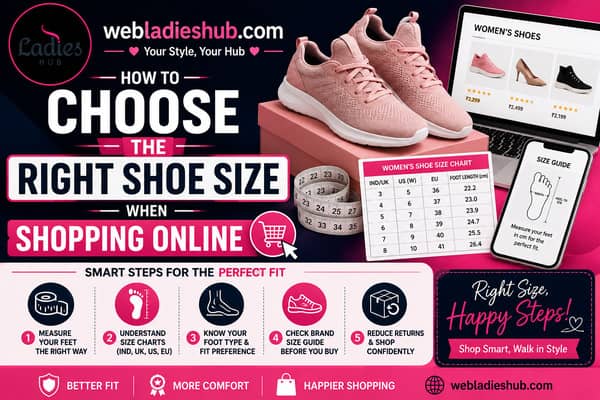
Buying shoes online feels convenient until the parcel arrives and your new pair is either squeezing your toes or slipping off your heels. For Indian shoppers, the problem can be even more confusing because websites may display UK/India, US or EU sizes, and the same size can fit differently across brands. Instead of simply ordering the number printed on your old shoes, a few quick checks can help you choose a much better fit and reduce the chances of returns or exchanges.
Quick Overview
| Check Before Buying | What to Do |
|---|---|
| Foot length | Measure heel to longest toe in centimetres |
| Foot width | Measure the widest part of your foot |
| Both feet | Use the measurement of the larger foot |
| Size system | Check whether the website uses UK/India, US or EU |
| Brand chart | Match your centimetre measurement with the brand’s chart |
| Customer reviews | Look for comments about narrow, wide, small or large fitting |
| Return policy | Prefer easy size exchange or return options |
Measure Your Feet Before Ordering
Do not depend entirely on the shoe size you have been wearing for years. Place a sheet of paper on a flat floor, stand naturally on it and mark the heel and the tip of your longest toe. Measure the distance in centimetres.
Measure both feet, because one can be slightly larger than the other. Use the larger measurement when selecting your size. Measuring later in the day can also be useful because feet may be slightly more expanded than they are early in the morning.
Always Check the Brand’s Size Chart
A UK/India size 8 from one brand may not feel exactly like size 8 from another. Even different shoe models from the same company can have slightly different fits.
Therefore, check the size chart available on the actual product page. Compare your foot length in centimetres instead of relying only on UK, US or EU size conversions.
Don’t Ignore Foot Width
Length is only half the story. If you have broad feet, a shoe with the correct length can still feel painfully tight.
Look for terms such as Wide Fit, Regular Fit, Narrow Fit or Extra Wide. For sneakers, running shoes and formal shoes, also pay attention to the toe-box shape. A wider toe box can provide better comfort for people with broad forefeet.
Read Fit-Related Customer Reviews
Customer reviews can reveal information that a size chart cannot. Search for comments such as “runs small”, “true to size”, “narrow fit” or “size up.”
Give more importance to reviews from customers who mention their usual size or foot measurements. This can be especially helpful when purchasing a brand for the first time.
Consider the Type of Shoe
Different footwear needs different fitting considerations. Running shoes generally need comfortable toe room, while formal shoes should feel secure without pinching. Sandals and slippers should keep the heel and toes properly positioned within the sole.
Also consider the socks you normally wear with that footwear. Thick sports or winter socks can noticeably affect the fit.
Check the Exchange Policy Before Paying
Even careful measurement cannot guarantee a perfect fit because shoe construction varies. Before placing your order, check whether size exchanges and returns are allowed, how many days you have, and whether the footwear must remain unused with its original packaging and tags.
For an unfamiliar brand, an easy exchange policy can be just as important as choosing the right size.